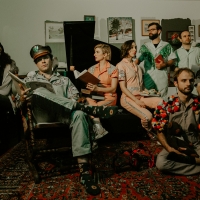
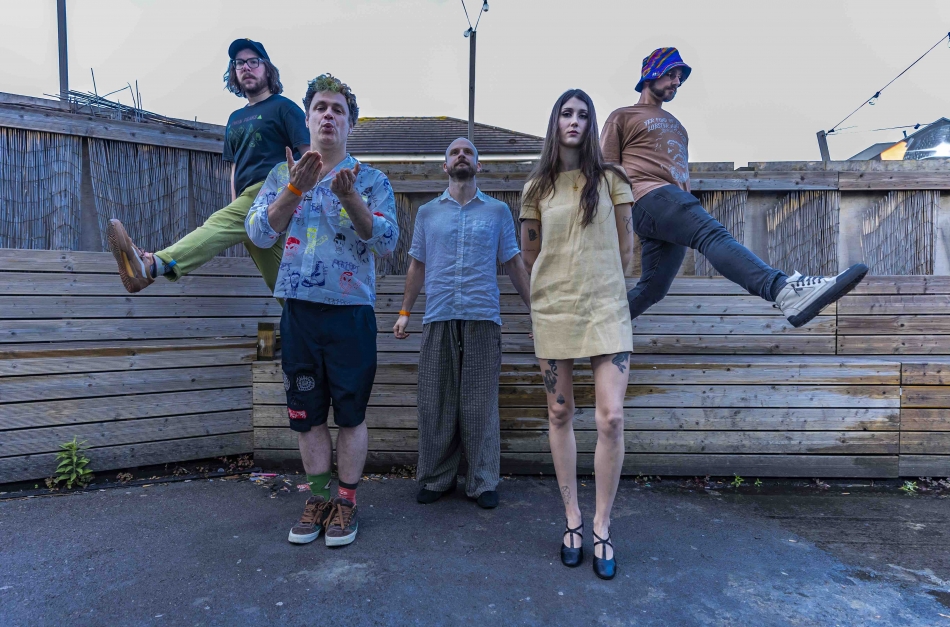
For more than two decades, NYC art-rock outfit Ecce Shnak have cultivated a musical universe where technical precision and inspired mayhem happily coexist. Led by composer, bassist and baritone vocalist David Roush, the band draws on hardcore, garage rock, classical music, experimentalism and a distinctly off-kilter sense of humor, creating songs that can be abrasive, absurd, surprisingly tender — and often all three at once. It’s music that rewards curiosity, particularly when Roush starts pulling apart the strange characters, relationships and cultural contradictions that inspire it.
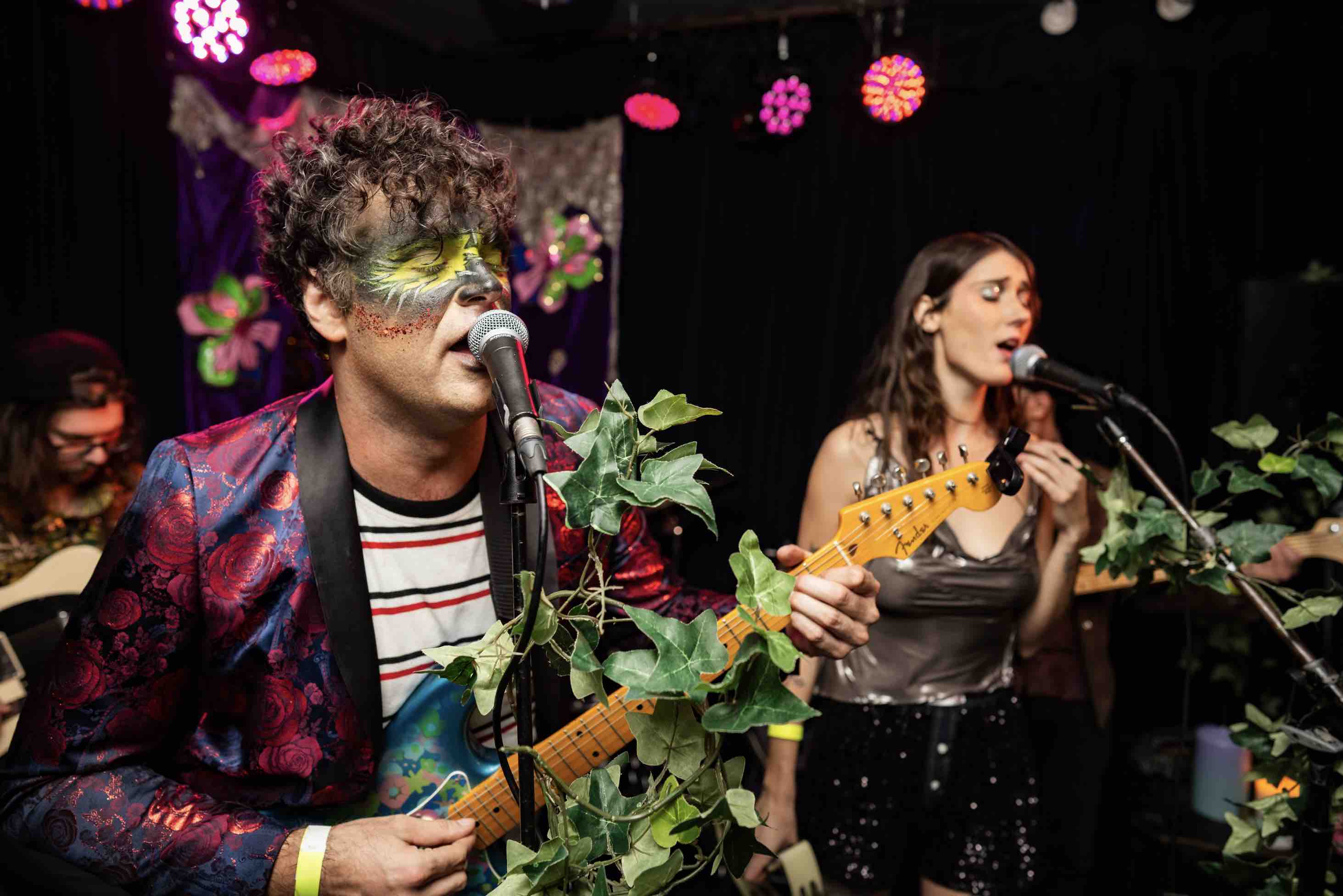
That restless spirit is on full display as Ecce Shnak enter a new chapter with Dandy Variances, their first full-length album in seven years. Following the album’s lead single “Vincent,” the band have now released “Eddie, Legalistic Homeslice” – a garage-rock character study that turns the complexities and absurdities of close friendship into a wonderfully strange, affectionate song. The accompanying Wes Anderson-hued video, featuring comedy duo Syd and Olivia, adds another layer to a band increasingly treating its music videos not as promotional afterthoughts, but as extensions of the songs’ personalities and narratives. Meanwhile, the arrival of vocalist Bella Komodromos has expanded the band’s sonic palette, bringing a new warmth and range to Ecce Shnak’s already unconventional arrangements.
And then there’s “Katy’s Wart” – a kick-ass song from their “Joke Oso” album, which has recently been given an extraordinary new life as a two-part cinematic music film. Inspired by Ovid’s Metamorphoses, The Twilight Zone, Quentin Tarantino and some wonderfully unlikely animation references, the project transforms a confrontational song about feminine resistance, patriarchal conditioning and self-defence into a surreal revenge fable. In the conversation that follows, Roush takes us deep inside that video’s symbolism and creation, talks candidly about the discomfort of playing its antagonist, reflects on Ecce Shnak’s collaborations and tours with EMF, and offers a glimpse into the ideas, friendships and creative chaos behind “Dandy Variances”.
Hi David. I have a few questions for you in no specific order, but all full of inquisitiveness about your next-level songmanship, artistry and views. Let’s dig in.
Hello friends! Absolutely no problem on the order of the questions. I like a bit of randomness in these, so I appreciate it actually!
I really dig your video for “Katy’s Wart”, which first appeared on your 2019 album “Joke Oso”. What originally inspired the song, and why did you decide that now is the right time to revisit it in epic video format?
Thank you so much for the props on that. Re: the inspiration for the track, I may have had a chip on my shoulder one day, some fun day long ago (probably a decade ago now, as I wrote it around 2014), and I just heard some nasty hardcore guitar riff in my head. I had been listening to the Meshuggah album that had been released around that time. Also, weirdly enough, the drums are inspired by a Questlove beat (Roots drummer)!
Thematically, the lyric and music video is about defending oneself when necessary. When I wrote the song, my twin nieces were still in high school. They were and are both wonderful, hilarious, charming, and charismatic people, which is a great thing in itself. However, in this demented world in which we live, the creeps and shmucks that run rampant all over the place might try to take advantage of and manipulate their warmth and openness.
The music video is basically an encouragement for them to throw down when necessary against said creeps and shmucks. The script comes from my love of the Twilight Zone and (speaking of creeps and shmucks) Quentin Tarantino (putting art waaay above artist on that reference!). Finally, the story of the animation was inspired by the mesmerizingly beautiful poetry of Ovid’s Metamorphoses, much of which are revenge tales with imaginative, evocative imagery. The style of the animation was inspired by the acid trip Beavis has in Beavis and Butthead Do America. We actually got the animator of that scene, Titmouse Productions, to make the animation. Oh yeah — and then there is this goofy 1980’s animated film called “Twice Upon a Time” that has its own effect on the piece.
This video presents the story in two forms—the three-minute animated “Music Feelm Version” and the ten-minute extended narrative. What sparked the idea to expand the song into such a cinematic, dual-format experience?
While there are a couple decent examples of the straight-ahead performance format of many music videos, in general, I find this to be boring. If you’re making a music video, why not lean into the medium to help tell the story? I feel that is a much better way to help my audience understand what the music is about lyrically, politically, spiritually, and morally.
The animated sequences have such a surreal, explosive quality. How did you collaborate with the team at Titmouse Productions to develop the super-fab look and feel of the five purple goddesses and that supernatural turning point? And what was it like working with Hollye Bynum and Sam Owens to bring that aesthetic into alignment with the song’s themes of feminine defiance and justice?
Again, I have to credit the Roman poet Ovid (who has been dead for 2,000 years) for writing his Metamorphoses. His use of detailed symbolism and metaphor inspired me to focus on the imagery in the video with as much intention as I could. I wrote the sequence of events I was imagining with as much detail as I could, timestamps and all. Many of the most salient images in the video are very specific metaphors or references to other things in our zeitgeist. Katy’s wart represents the young ladies’ power to resist the creep, even if it might be unsightly. Though her sister Gillian mocks her for the gross wart on her hand in the beginning of the video, she knows that it will ultimately prove to be their best defense as the creep makes his approach. The creep’s rib is a Biblical reference to the rib of Adam which God transformed into Eve.
In the story of the video, however, the goddesses transform it into a coat-hanger. This refers to the fact that women denied reproductive freedom often resort to the use of coat hangers to exercise their autonomy, dangerous as that method might be. Here, however, they sharpen it into a weapon to slay the creep. Finally, the goddesses magically change the attire of the creep from his generic business suit into swimming attire. This is a reference to Brock Turner, the young man who took advantage of a woman after he drugged her, as was a swimmer in college. He served only three months of a six months sentence. In this music video, this creep meets arguably a more deserved end.
Hollye Bynum and Sam Owns are shit-kickers par excellence. They are brilliant and diligent and were instrumental in making the video come to be as a production team. The connected us with Titmouse, cast the incredible duo who played Katy and Gillian, and knocked out really every detain of the film as I had imagined it. Oodles and oodles and oodles of gratitude to them both!
The extended version’s live-action storyline—featuring the twin sisters being followed by a well-to-do maniac—adds a tense, grounded layer before the cosmic intervention. How involved were you in developing that scenario and script, and what was your experience like performing in the video as part of that narrative?
I wrote most of the script, but the two other actors Rebecca and Rachael Rae Robertson, improvised the first minute or two of the video and most of the closing passage. In my first version of the script, I imagined the creep’s character as an unattractive guy without any charisma or command over the situation whatsoever. A woman I was seeing at the time read it and rejected that aspect. She told me, “If you are playing this character, you need to try to look as good as you can. You need to exude a power that our system unfairly privileges.” I appreciated this critique, changed the character, and dug into the script on a second draft to incorporate this very sound advice.
Playing the character was difficult, as we had no rehearsal or acting coaching, so I was just coasting off of what I remembered about acting from high school and what I appreciate in performances I have seen. But I have come across people like the character I played over the course of my life, and so I tried to develop his backstory and my portrayal of his flawed soul from my experiences with people like him and what I understand of how they operate. Though I am proud of the film generally, I felt quite sick of myself at the end of that performance. It made it easier, however, that Rachael and Rebecca knew who I really am (even though we barely knew each other) and that we were telling a story together.
The neighborhood we shot it in is a quiet, upper-class, suburban neighborhood in Long Island with American flags on every other lawn. I felt both a little vindictive satisfaction to disturb the peace of the neighborhood by screaming like an asshole, but I was also worried about the fact that nobody saw the happy ending of the film we made. Maybe they caught it on YouTube later, or maybe they’ll read this interview and check it out later.
Lyrically, “Katy’s Wart” reads almost like a satirical manifesto before it erupts into something far more confrontational. How did you approach writing those words, and what emotional or cultural tensions were you channeling at the time?
I wrote a couple paragraphs of what I imagined might be an excerpt from some book with a title like How to Raise Girls to be Obedient Women, or some drivel like that. The lyric is supposed to serve as the sexist internal narrative that people (and most significantly women) live with that limits their power, sense of themselves, and sense of each other. One emotional tension I carry around is an awareness that I live within this system, am downstream of patriarchal conditioning, and have my own flaws. One must work steadily and continuously to slough off these entrapments and alienations. No one’s an overnight hero, but I am in it for the long haul.
You recently toured with platinum-selling UK band EMF and even appeared on their single “LGBTQ+ Lover.” What did you take away from that collaboration and touring experience and might we see you collaborating together in future?
The EMF dudes and their crew are absolute gems. Their music kicks ass and they are funny, caring, helpful, and fascinating blokes. When I think of the three tours we have done with them and that collaboration, I feel the utmost joyful pride and connection with people I love and care for. It’s a kind of “I will carry those memories and lessons to my last moments” feeling.
With regards to a future collaboration, we have not made any firm plans yet, but we were kicking around the idea of writing and recording together while we were on tour! The band had already completed “LGBTQ+ Lover” by the time Bella and I started performing it with them live on the third show of our West Coast tour in June of 2025. But this idea in oveo would be a legit full composition from scratch. I absolutely love this idea and hope to make it come to be soon! It gives me reason to reach out to them and see if they’re still down. Thanks for the reminder!
2025 has already been a huge year with the release of your “Shadows Grow Fangs” EP and the follow-up live “Backroom Sessions” EP. How do these releases reflect where the band is creatively right now, and how does it set the stage for the upcoming “Dandy Variances” album?
Both of those albums are the first Ecce Shnak releases that feature Bella, our soprano. I love all of the music the band has released, but Bella’s voice lends so much warmth, depth, and range of color to the vocal texture. The songs on “Backrooms Sessions” EP are live performances of music we had already released. While I love to record big old multi-track projects with a million performances, there was something very fun and very crucial for us to trust the five of us and make the songs work as we play them live. We are releasing another live EP with the same concept in addition to “Dandy Variances” this fall. This EP will feature 6 songs and will be called “the Red Wheelbarrow” based on a William Carlos Williams poem of the same name that we read together and discussed during a van ride on tour.
You have a new single out this week, previewing your upcoming album “Dandy Variances”. Tell us about these singles.
We have released two single for the upcoming full-length album, “Dandy Variances.” It is our first full-length album in friqq’n seven years, so we are a bit anxious with excitement.
Both of our two first singles are in a genre of Ecce Shnak songs that you might call “character studies.” Most of them have somebody’s name as the title. The subjects are sometimes real people and sometimes allegorical figures or imaginary folks.
The first single “Vincent” is a mid-tempo hardcore slamdance track with classical art-song vocals. The subject is an archetype of a run-of-the-mill douchebag. He’s not a complete scoundrel, but is lame enough to merit some shit-talking and mud-slinging. The song is an exhortation to not suffer these fools lightly, and to dispense with them with your genuine self, as exemplified by the closing vocal refrain. Bella and I repeat the phrase “I’ll destroy your equipment with my voice” with increasingly soaring harmonies before the conclusive big instrumental hit of the song, right on the “1” of the last measure.
The second single, “Eddie, Legalistic Homeslice,” is also a character study, in fact! This song, however, stands in stark contrast to “Vincent,” both in the spirit of the lyric and in the musical style. It is a slightly faster garage-rock song that recalls Dinosaur Jr., Weezer, and the Flaming Lips. The “Eddie” who is the song’s subject is a dear friend of mine, and the song is an earnest homage to him, something like a “platonic love song.” Sometimes, it is easy to project a lot of confused psychological stirrings onto the people we love dearly. In so doing, we often misunderstand them profoundly and ridiculously. The lyric is an account of my own experience with this interpersonal hiccup and the comedy of errors that it can cause, culminating in what the lyric claims is the “oldest prayer” of friendship. This oldest prayer of friendship is an emphatic Rivers-Cuomo-like plea: “I pray you don’t be a rat in a rat suit/pray you don’t be a rat in a rat costume.”
Man, you certainly have been busy. We look forward to all that you’ve got coming for us and wish you every success. Do you have anything more you’d like to share?
Thank you so very much for this opportunity to share some of these thingamajigs about Ecce Shnak with your readers. We can’t wait to share “Dandy Variances” with you, we can’t wait to see you on tour this Fall (we’re working on dates!), and we also hope you check out our old music. From oldest to most recent, the releases are as follows:
“Letters to German Vasquez Rubio” (2013 EP)
“Joke Oso” (2019 EP)
“Metamorphejawns” (2019 LP)
“Shadows Grow Fangs” (2025 EP)
and “Backroom Sessions” (2025 EP)
Thanks David – we wish you every success and expect to see continued great things from you in 2026 and 2027.
ECCE SHNAK ON THE INTERNET
Facebook | Bandcamp | Instagram | Twitter
YouTube | TikTok | Spotify | Apple Music