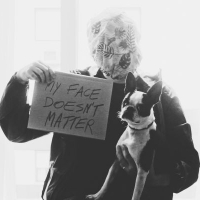
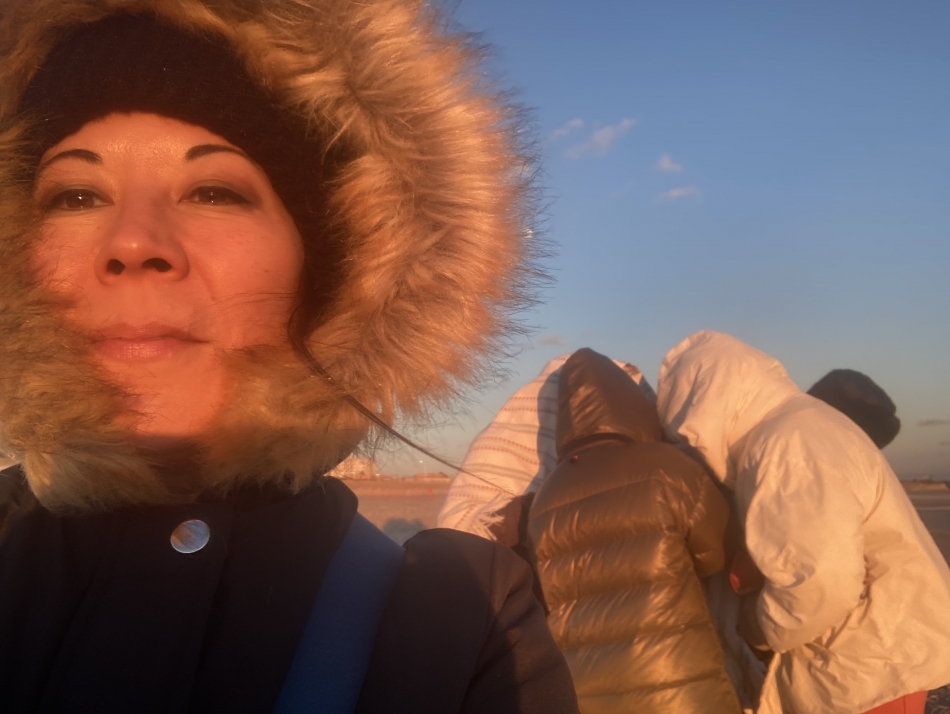
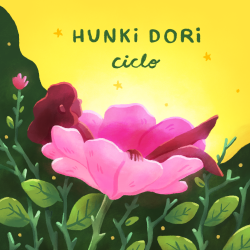
Hunki Dori is the solo vision of songwriter and multi-instrumentalist Dorothea Tachler, an artist who treats repetition not as a constraint but as a canvas. Her latest album, Ciclo, unfolds in patient, looping patterns that gradually evolve, pulling listeners into a steady, lived-in groove. Built from layered instrumentation and subtle shifts in texture, the record blends ambient warmth with a rhythmic pulse that feels both meditative and physical. Field recordings from New York City and Seoul drift through the mix, grounding the music in real places and fleeting moments. We caught up with Tachler to talk about process, collaboration, and the quiet momentum behind Ciclo.
When you begin an instrumental piece, do you usually start with rhythm, harmony, texture, or atmosphere?
It depends. Usually I start with a little pattern, a riff, a melody, and then build on top of it and let it kind of go its “natural course.”
But sometimes I start with a texture if I’m really intrigued by a sound.
How do you prevent repetition in cyclical music from becoming static?
By always having at least one element that is not repetitive, e.g. an instrument that improvises on top, or has a longer free form or solo, or field recordings of environments, nature, people’s conversations. Since these go in real time, I feel like there’s a different timeline happening over the cycles, so I feel like they’re not static. But I guess it depends on the listener and what part they focus on.
What does “melody” mean to you in a project where vocals aren’t the focus?
It means the melody becomes the focus, the narration or narrator. Sometimes, it’s like saying what the lyrics would say, just without words.
But it can express a feeling, even a story or situation.
How do you approach arranging layers so that each part feels necessary but not crowded?
By bringing elements in one after another and letting some fade out, sometimes giving each instrument or pattern a “turn,” so they don’t all happen at the same time. Though there could be parts where it is crowded, that can also express something we relate to in life.
Are there specific production techniques you rely on to create warmth and motion in your recordings?
Probably, yes. Mostly using real instruments over MIDI. I feel like certain instruments and harmonies can create more warmth, like nylon guitar and strings, upright bass, sometimes piano. Though it depends how you record and mix it. Overall, I guess it’s about staying true to a feeling of warmth.
How do you decide which sounds should sit in the foreground and which should remain more textural?
I let myself be guided by what sounds and feels good to me in the situation. I don’t really have a concept here. When I’m not sure, I play around with the elements until it sounds “right,” or it “clicks.”
Has working between cities like New York and Seoul changed the way you hear or structure instrumental music?
Definitely. New York has changed it just because of the richness and diversity you can find here in music. For example, you will hear a lot of Latin music here.
What role does rhythm play in shaping emotional movement within your tracks?
Rhythm might play a more subtle role here, but it depends on the track and which part of the track.
I think rhythm, used right, can definitely create emotional emphasis or narration. Rhythm can express a static state, or how things can open up or fall apart. I use it more intuitively when I am in the middle of a piece and feel like there’s a different rhythm, pattern, or faster passage needed to express an emotion. But I don’t often use rhythm as a starting concept to shape emotional movement.
How do you balance precision and looseness when recording instrumental parts?
Yeah, that’s a good question. I don’t want my pieces to be stagnant. I want them to breathe and be alive. Rhythmic precision is important or I lose orientation, though sometimes a piece that is totally free in rhythm and meter can also be intriguing.
To me, I like it when it sounds loose and free, but I don’t like it when it’s sloppy or out of tune. There is freedom in rhythm, meter, and pitch that can be very charming, but there’s a line where it stands out in the wrong way.
When performing these pieces live, do they stay close to the recorded versions, or do you treat them as open frameworks for reinterpretation?
Both can be true. Sometimes it is fun to try to reconstruct all the parts live using my loop station. And sometimes I just use the starting loop and build a completely new version of the tune on it. Sometimes I also completely improvise a piece, or even an entire set.