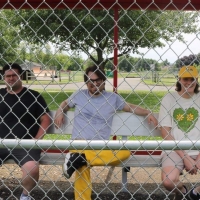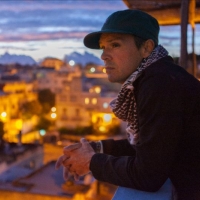
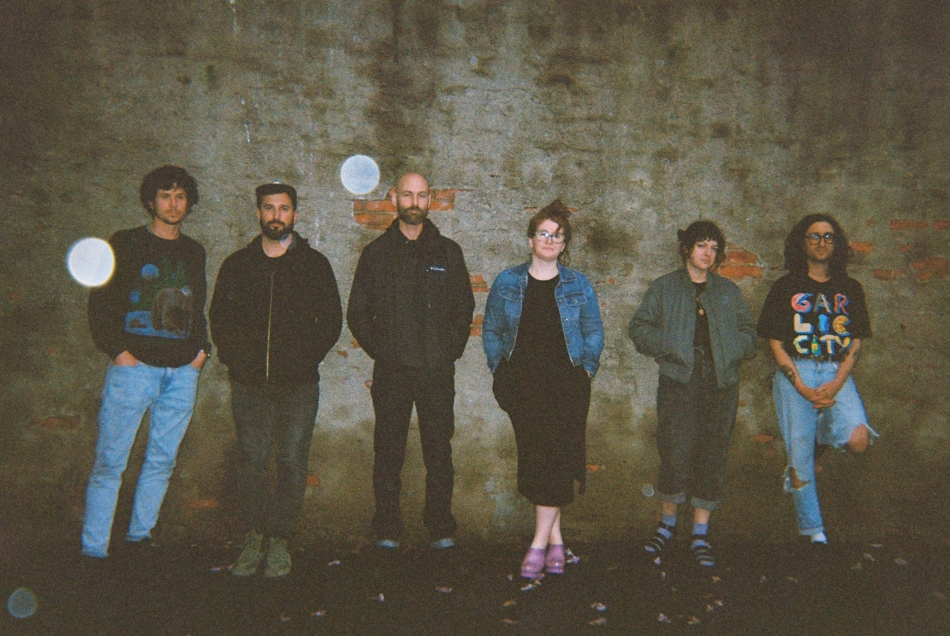
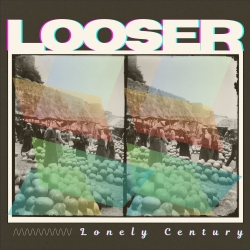
Crank it up and get ready—Philadelphia’s Looser are here to blow the dust off your playlists. With a sound that slams together ‘90s slacker cool and the neon sheen of ‘70s and ‘80s power pop, this six-piece outfit is the kind of band that makes you want to dance, cry, and maybe smash a guitar—all at once. Think Pavement meets The Cars, with a little Breeders bite and Big Star shine. After a string of gritty, home-recorded gems, Looser have leveled up with Lonely Century, their debut LP: ten tracks of sharp, hook-laden rock that’s as heart-worn as it is high-energy. Led by the razor-sharp songwriting of frontman Tony Aquilino and powered by a tight, DIY-driven lineup—Zac Ciancaglini (drums/production), Russell Langley (bass), Gabe Wilhelm (guitar), S. Catoe (synths/cello), and Megan Gouda (backing vocals)—Looser are turning emotional wreckage into power-pop gold.
We caught up with Tony to talk about the band’s origins, the making of Lonely Century, and what’s next for Looser as they bring their fuzzed-out anthems to a stage near you.
Q: In your opinion, what are the essential qualities that make a “good songwriter”?
Songwriting is a storytelling art form, so I think understanding that and approaching songwriting that way is essential to good songwriting. Even instrumental music has an emotional arc and tells the listener some kind of story.
Good songwriters also respect their own creative process, understand their own strengths and weaknesses, and know how to use them as tools in creating something memorable. A big step in my personal songwriting journey was coming to grips with how limited my guitar skills are, and accepting and working within those limitations, while focusing on other aspects of the song–vocal melodies, structure, movement, dynamics, storytelling–rather than trying to write impressive guitar parts.
Another quality of a good songwriter is understanding the song as a living thing and knowing how to follow where it wants to go and understanding how to develop and flesh out a song in a way that serves the song.
Q: What is the basis for writing attention-grabbing music in this day and age?
I think the essential elements of songwriting still appeal more than anything—strong, memorable melodies, interesting lyrics and delivery, interesting sonic elements. I think songwriters/musicians have less time to grab attention now, so they need to get their message across right out of the gate and be really economical in how they structure their songs. There’s probably less room for sprawling arrangements and long instrumental intros and things like that. I don’t think shorter attention spans are an outright good thing, but I do think there’s some positive element to having to be economical with your songwriting. The three-minute pop song is itself an evolution of song structure borne out of changing attention spans and limitations of format.
Q: Can you pinpoint some specific songs and songwriters that changed the way you write music?
I’ve been a huge Wilco fan since forever, and have read two of Jeff Tweedy’s books, and I find his views on songwriting so valuable and inspiring. He really knows how to maintain practical habits while tapping into deeper emotional experiences. As someone who struggles with writer’s block, I’ve picked up so many useful tools from his writing to stay on-track and generate new and exciting ideas.
I love Liz Phair’s songwriting. I think she’s great at immersing the listener with lots of great specific detail. She’s also said that she mostly writes in-character, and the person she plays while writing and performing isn’t necessarily her everyday self. Hearing that definitely helped me give myself permission to write outside of myself and my own experiences, or to sort of blend them with a fictional perspective to tap into something more emotionally universal.
I also feel like there’s been a shift in lyrical style among contemporary young songwriters that I really appreciate. I really love Phoebe Bridgers’ lyrics. She’s so great at using detail to create really vivid poetic imagery. I also love MJ Lenderman’s blend of surrealness and gritty realism. He’s really great at creating characters whose lives feel so believable but also so absurd.
Q: Do you find it hard to be inspired by your peers? Can you name any new artists you find inspiring?
I love keeping up on the music my peers are making, and find it incredibly inspiring. Philly is such a great music city, and living here has really shaped my sound and my approach to songwriting. My favorite way to discover new artists is still terrestrial radio. When I’m at home I’m pretty much always bouncing between WKDU, WPRB, and WXPN. Even with unlimited access to music via streaming, there’s something special about knowing that a real person is playing tracks that are exciting to them, and knowing that you’re sharing this experience with the DJ and with the other listeners tuned in.
One of my favorite Philly bands that I first heard on WKDU is 2nd Grade. Peter is such a talented songwriter with a fantastic sense of melody, and the band has such a great sound. Another band that really blew me away recently was Planette Automatic, who are sort of a spin-off of The Lunar Year. Great songs, really cool lyrics, and really creative approaches to melody.
Goodnight Lights is a band I’ve known for years, and they are just so amazing and deeply underrated. I also just discovered the band Sacred Monsters, who tread some similar sonic territory to us, but in such a cool and creative way. We’re also lucky to be putting out our record on the label Mint 400, whose roster includes a bunch of my current favorites–Christina Ward, Yawn Mower, Those Looks, and Renee Maskin, off the top of my head.
Q: For your new album, what inspired the lyrical content, album title, and overall vibe?
The songs on Lonely Century have a running theme of boredom, loneliness, and isolation in an age when social media and technology promised us constant and limitless connection. A lot of the experiences I tapped into date back to my early 20s, when I had dropped out of college and was working an extremely boring office job that I spent a ton of time commuting to in a car by myself only to talk to a bunch of strangers on the phone all day.
I think it’s a really typical American experience, especially in late capitalism where so many jobs have become so abstract and understimulating. This experience for me was also around the rise of social media, where suddenly I was peering into everyone else’s incredible and glamorous lives, even if what I’m seeing is a curated projection. But that also makes it harder to gauge what’s real and what’s not, and what I should be shooting for in my own life. A lot of the songs are about digging back into our humanity and finding joy and emotion and human drama and all that stuff that makes life worth living, which is still out there. So it’s not all doom-and-gloom/phone bad/world bad kinda stuff. Even though the world right now is pretty bad and our phones are emotionally and physically killing us haha.
Q: Do you find that you ruminate over writing songs and hold on to them for a long time before including them on a record? Or do you prefer to write them, release them, and be done with them? Do you ever re-visit old material to do a re-write or once it’s done it’s done?
I’m sort of 50/50 on returning older material. When Zac and I first started talking about making this record, we were going to do a five-song EP that was all hi-fi, full-band re-recordings of my older 4-track recordings we ended up including “No Line” and “Tonight”, but I had a bunch of new songs written and really wanted to move on from most of the older stuff.
Some of the newer songs, though, were born out of ideas I had been sitting on for a while. “Sober” was based on a guitar riff I had used in an older song, reimagined and recontextualized, which sort of let a brand new song vocally/lyrically/structurally to flow out of it. I definitely have a few songs in my back pocket that predate some of the songs that made it onto this record, but didn’t feel finished yet.
Q: Were there any lessons you learned in the writing and recording process for your current release that you will take with you into your next project?
Oh man, sooo many, haha. We had a running joke about “learning experiences” because like every other week we’d make some major-seeming fuckup and have to redo something and set ourselves back another month.
The biggest thing I learned as a songwriter/arranger is to hone in early on what you want the vibe to be, and to try not to fall into the trap of endlessly adding elements to try to achieve the sound you’re going for. My earlier demos for this record had tons and tons of tracks—especially guitar tracks—so when we went to record for real, we sorta followed that roadmap and ended up with some really complicated, cluttered mixes that were really hard to dial in dynamically. Songs that were written later, like “Friends” and “Sober” were way more economical with their tracks, and likewise were way easier to track with the band and ultimately mix. They also had a lot more dynamics baked into the arrangement, so we didn’t have to do as much automating and stuff to signify verses vs. choruses, etc.